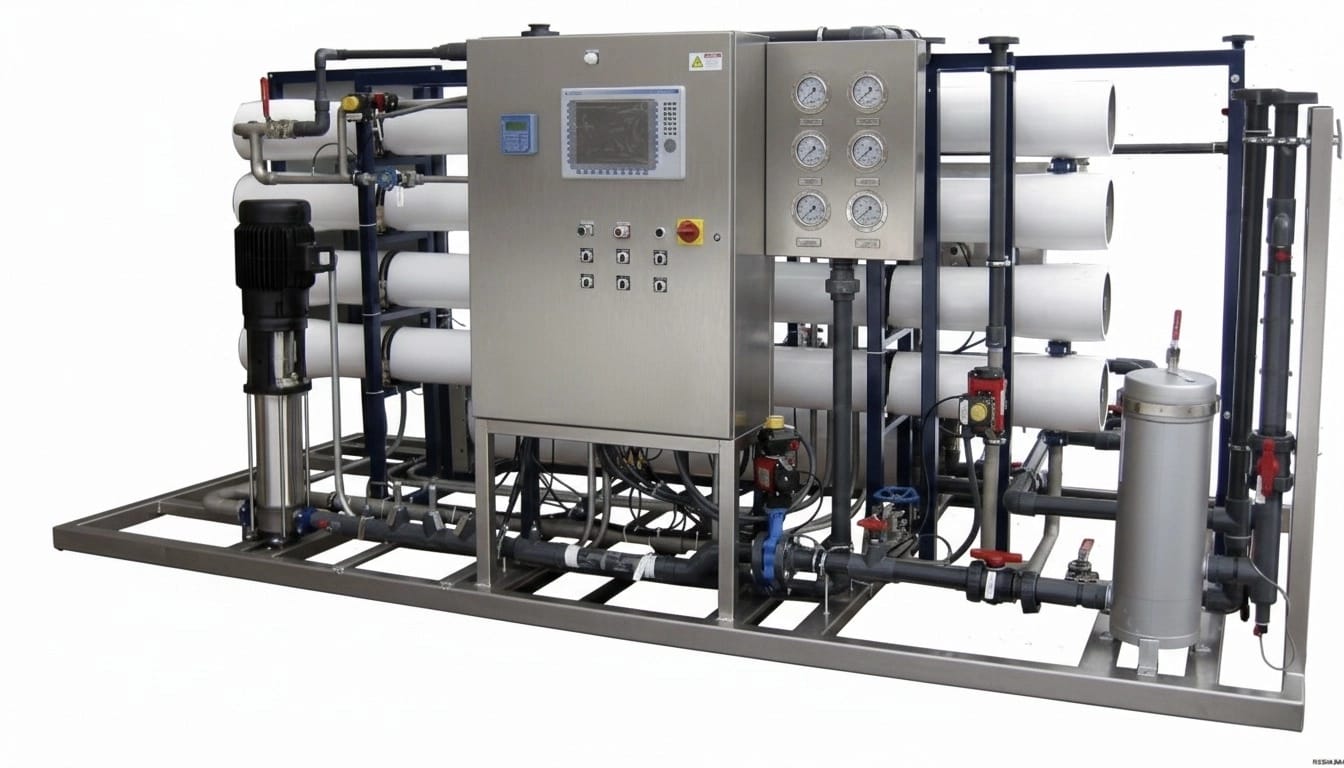


FiltraCore Asia’s WTX-IND™ Series is an engineered range of non-sanitary industrial water-treatment systems developed for factories, workshops, utilities, centralised water rooms, and process facilities that require stable treated water, robust operation, and long-term cost efficiency—without the sanitary or hygienic premium associated with GMP or pharmaceutical production. The WTX-IND™ platform consists of two industrial subclasses: WTX-IND-RO™, representing FiltraCore’s industrial single-pass reverse osmosis systems, and WTX-IND-UF™, representing the industrial ultrafiltration systems.
Both subclasses are engineered using industrial-grade design practices, durable material selections, and automation approaches suitable for heavy-duty operations exposed to variable feed-water conditions. While intentionally non-sanitary in nature, the WTX-IND™ Series is built on FiltraCore Asia’s disciplined approach to system protection, pretreatment integrity, and downstream equipment preservation—ensuring reliability, serviceability, and stable long-term performance across demanding industrial environments.
WTX-IND-RO™ – Industrial Single-Pass RO Systems
WTX-IND-RO™ systems are engineered for industrial clients requiring reliable TDS reduction, scale control, and stable permeate production through single-pass RO configurations. These systems are suitable for manufacturing plants, cooling-tower feeding, boiler-feed RO, general industrial process water, central utility water preparation, rinse-water generation, and non-hygienic zones within food and beverage facilities.
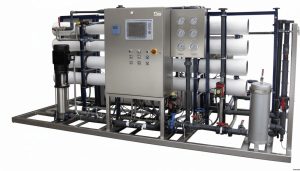
The core architecture begins with an industrial-grade pretreatment train consisting of multimedia filtration, activated-carbon filtration, and either nominal or absolute cartridge filtration within the 1–5 µm range, with absolute-rated cartridges recommended for RO membrane protection. Chlorine removal is accomplished through ACF or sodium bisulfite dosing, as polyamide RO membranes are highly chlorine-sensitive and must be protected against oxidative degradation.
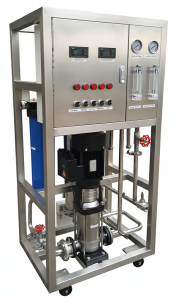 The RO process uses single-pass spiral-wound polyamide thin-film membranes capable of delivering 95–99% TDS reduction, with actual performance dependent on feed-water quality, silica loading, and scaling potential. Membrane housings are supplied in FRP as standard, with stainless-steel housings available as an option when required by environmental, mechanical, or customer-specific criteria.
Typical output quality ranges from 5–50 ppm TDS, subject to feed condition and pretreatment effectiveness, with an upstream SDI requirement of <3, supported by UF, ACF, or cartridge polishing where necessary.
Optional post-treatment modules include pH conditioning, remineralisation or alkalinity balancing, and chlorination or UV disinfection. Remineralisation is recommended whenever RO permeate is stored in stainless-steel tanks, as permeate water is naturally low in ionic content and can be corrosive without stabilisation.
WTX-IND-RO™ systems are deployed across industrial utilities, textile and plating operations, general manufacturing, cooling systems, surface-preparation lines, and boiler-feed applications where softened or low-hardness feedwater is required for optimal performance.
WTX-IND-UF™ – Industrial Ultrafiltration Systems
WTX-IND-UF™ systems are designed for industrial users treating surface water, river water, well water, or variable municipal feeds, where turbidity, suspended solids, and seasonal fluctuations make consistent water quality difficult to maintain. UF delivers high-efficiency turbidity reduction, stable SDI performance, and robust protection for downstream RO membranes or sensitive process equipment, making it one of the most dependable pretreatment technologies for challenging raw-water sources.
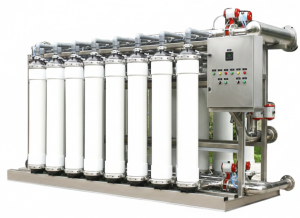 The pretreatment stage typically incorporates multimedia filtration, activated-carbon filtration, and coarse inline strainers within the 80–150 µm range to remove larger particulates and protect the UF modules from abrasion and fouling. The ultrafiltration process then utilises hollow-fibre outside-in membrane modules with pore sizes in the 0.01–0.03 µm range, enabling the removal of suspended solids, colloids, microorganisms, and fine particulate matter. This configuration consistently produces turbidity below 0.1 NTU and achieves SDI₁₅ values below 3, often reaching <2.5 when treating surface-water sources. Chemically enhanced backwash (CEB) regimes can be incorporated to maintain long-term performance under more challenging feed conditions.
Disinfection capability is enhanced with 254 nm UV as a standard feature for microbial suppression, while 185 nm UV can be integrated where TOC reduction is required for downstream process stability, high-spec manufacturing, or water-reuse applications.
WTX-IND-UF™ systems are deployed in surface-water treatment, production-water conditioning, RO pretreatment, wastewater recycling for non-potable reuse, cooling-tower make-up water, and general industrial operations requiring consistent low-turbidity water with predictable SDI performance.
Shared Optional Modules (Applicable to Both RO & UF Systems)
WTX-IND systems can be enhanced with a suite of optional treatment modules designed to manage feedwater variability, scaling tendencies, microbial load, and long-term operational stability. For hard water sources, a water-softening module may be introduced to reduce calcium and magnesium hardness, particularly important when preparing RO feed for boilers or high-temperature processes. Where alkalinity or silica conditions require control, a pH-conditioning system can be integrated to stabilise CaCO₃ behaviour and reduce membrane-scaling potential. For RO configurations operating at higher recoveries, an industrial-grade antiscalant dosing module may be incorporated to maintain stable flux and prevent inorganic fouling.
To safeguard polyamide RO membranes against oxidation, sodium bisulfite (SBS) dosing is available for continuous or demand-based dechlorination, especially when treating chlorinated municipal water. Downstream of RO or UF, permeate can be stabilised through a remineralisation or alkalinity-balancing module, recommended when storing low-TDS water in stainless-steel tanks, as purified water is naturally aggressive and may cause corrosion without proper stabilisation.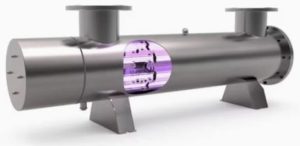
For enhanced purity or process-specific requirements, WTX-IND systems also support advanced polishing options, including 185 nm UV for TOC reduction, 254 nm UV for microbial disinfection, sub-micron polishing, and EDI modules where semi-hygienic or electronics-grade water is required. These optional upgrades allow each WTX-IND configuration to be adapted to site conditions, water-chemistry challenges, and long-term operational objectives without altering the core skid architecture.
Compliance & Engineering Standards
WTX-IND™ systems are engineered in alignment with recognised industrial water-treatment standards, incorporating design practices referenced in AWWA guidelines, ASTM membrane-system recommendations, and ISO performance frameworks for RO and UF technologies. The systems also follow the engineering principles established by major RO/UF OEMs for flux management, fouling control, membrane protection, and reliable recovery rates. These standards ensure that WTX-IND™ delivers predictable performance, operational reliability, and long-term durability across diverse industrial environments, while avoiding the unnecessary cost premiums associated with sanitary-grade or pharmaceutical-grade equipment.